Here is a mass budget for a 1-GW AI data center in space. It is intentionally simple enough to audit and intentionally incomplete enough not to be mistaken for a flight proposal.
Start with a real system specification
NVIDIA's DGX B200 system is a useful packaging proxy because it is a complete eight-GPU server, not a bare accelerator. NVIDIA lists maximum system power of 14.3 kW and maximum weight of 142.4 kg. Divide a 1-GW IT load by the maximum system draw:
Round up to 69,931 systems. At eight GPUs each, that is 559,448 GPUs. Their listed maximum power is 69,931 × 14.3 = 1,000,013.3 kW, essentially 1.0 GW. Their listed maximum system mass is 69,931 × 142.4 kg = 9,958,174 kg, or about 9,958 tonnes.
This assumes every system runs at its maximum power continuously and that the measured maximum weight represents the delivered orbital unit. It does not include racks, network switches, cabling, storage, spares, radiation protection, server replacement inventory or the structures that hold the systems in place. The vendor specification is a useful floor for counting boxes, not a space qualification.
Power generation has its own mass
Give the orbital system 1.6 GW of solar array output under favorable illumination. That is 33% above the 1.2-GW facility load, but it is not an eclipse or storage design. At an assumed specific power of 100 W/kg, the arrays weigh 1.6×10⁹ W ÷ 100 W/kg = 16,000,000 kg, or 16,000 tonnes, before support structure, deployment hardware, cabling, power conversion or batteries.
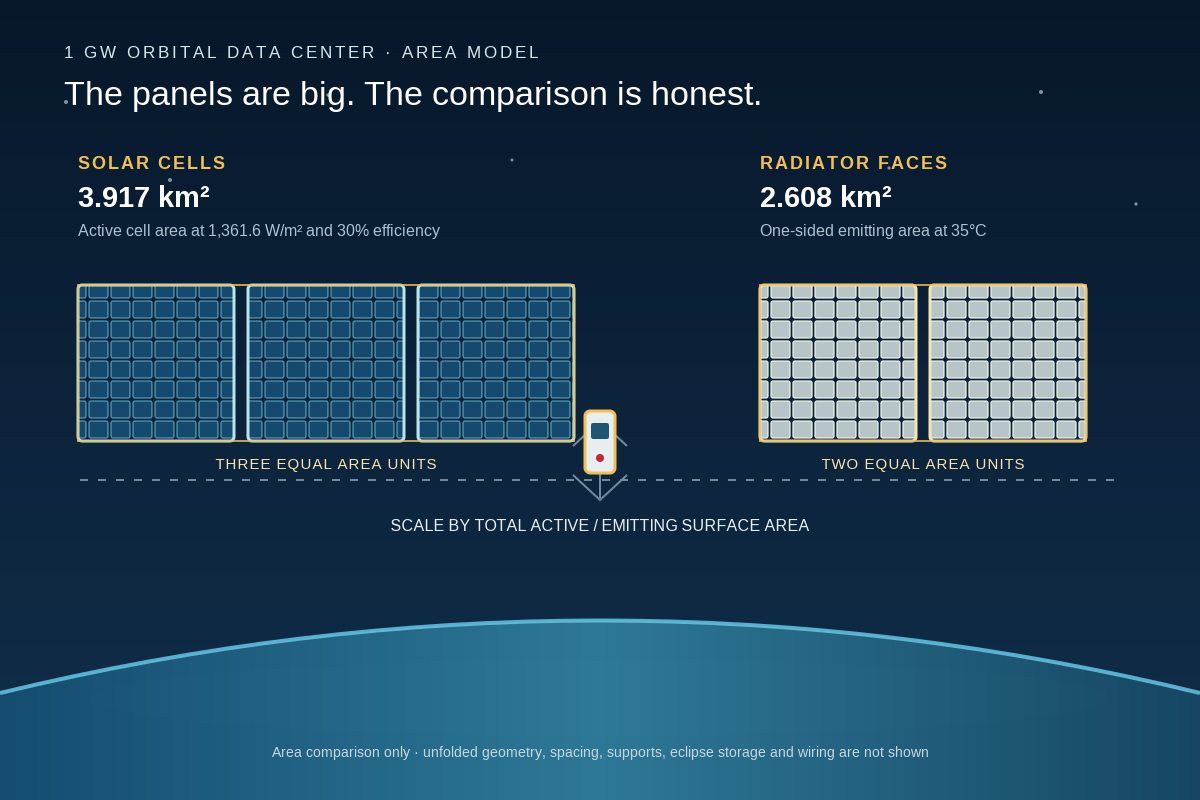
For a separate active-cell area check, NASA reports total solar irradiance near Earth of 1,361.6 W/m². At an assumed 30% cell efficiency, the active area for 1.6 GW is 1.6×10⁹ ÷ (1,361.6 × 0.30) = 3.917×10⁶ m², about 3.917 km². This is cell area under direct, normal sunlight. It is not the physical envelope of an array, and the orbital geometry and eclipse schedule remain unspecified.
Then add the heat rejection system
The thermal series article uses a 1.2-GW heat load, emissivity 0.90, a 25°C chip-to-radiator temperature difference, and a radiator surface density of 5 kg/m². Under those assumptions, the radiator mass changes sharply with radiator temperature:
| Assumed chip temp. | Radiator temp. | Radiator mass | Total modeled mass | 100 t payload flights | Launch-only cost at $50M/flight |
|---|---|---|---|---|---|
| 60°C | 35°C | 13,039 t | 44,997 t | 450 | $22.50B |
| 100°C | 75°C | 8,003 t | 39,961 t | 400 | $20.00B |
| 150°C | 125°C | 4,679 t | 36,637 t | 367 | $18.35B |
| 200°C | 175°C | 2,915 t | 34,873 t | 349 | $17.45B |
Each total is calculated as 9,958 tonnes of DGX systems + 16,000 tonnes of solar arrays + an assumed 6,000 tonnes for support hardware + the radiator mass. The 6,000-tonne support allowance is a placeholder, not a detailed bill of materials. It has no line-item backup yet.
The final column assumes exactly 100 metric tonnes of useful payload delivered to the operating orbit per flight and $50 million per flight. SpaceX describes Starship as designed to carry more than 100 metric tonnes to orbit in a fully reusable configuration. That is a design target, not a guaranteed delivered mass for this mission, with its destination, deployment, transfer, refueling and recovery requirements. The $50-million price is an analyst's scenario input, not a published SpaceX quote.
At the 100°C chip case, for example, 39,961 tonnes divided by 100 tonnes per flight rounds up to 400 flights. Four hundred times $50 million is $20.0 billion in launch charges alone. The other cases produce 349 to 450 flights and $17.45 billion to $22.50 billion under the same simple rules.
The flight curve has a floor that this chart cannot show: the systems must be packed, launched, connected, cooled, commissioned, and repaired. Payload mass is only one constraint. A 100-tonne delivery limit assumes the cargo is compatible with the vehicle, can be carried to the specified orbit, and arrives intact. It says nothing about usable volume, vibration limits, radiator dimensions, or whether the payload can be unloaded and assembled safely.
What is missing from this mass budget?
Quite a lot, and the omissions point in the same direction. The calculation does not size batteries or account for orbital eclipses. It does not add radiators' support frames, coolant, pumps, valves, heat exchangers, spare loops or repair equipment. It does not add computing network fabric, storage, power conversion, shielding, attitude control, station keeping, micrometeoroid protection, assembly robots or the equipment used to deploy the arrays.
It also treats each tonne as if it can be launched in the same configuration and assembled without loss. A payload mass budget is not an operations plan. Three hundred and fifty to four hundred and fifty successful deliveries are already an enormous campaign before counting propellant depots, launch turnaround, orbital assembly, replacement cycles or schedule risk.
There is a second counting issue: the installed system must continue operating when components fail. Training clusters normally use spare accelerators, redundant network paths, storage replication, service clearances, and replacement inventory. This mass model counts neither downtime policy nor repair strategy. If a failed pump disables a large thermal loop, spare pumps and isolation valves are not optional luxuries. They are uptime hardware, and they belong in the launch budget.
The mass estimate is still useful. It exposes the central engineering trade: radiator temperature can save thousands of tonnes, but every additional degree moves risk into the silicon, coolant, packaging and lifetime. And the solar array is not a small accessory. Under the 100 W/kg assumption it weighs 16,000 tonnes by itself, more than the server systems.
Sources and reading notes
- NVIDIA DGX B200 User Guide, eight GPUs per system, 14.3 kW maximum system power and 142.4 kg maximum weight.
- NASA Total Solar Irradiance observations, 1,361.6 ± 0.3 W/m² at the 2019 solar minimum.
- SpaceX Starship, design claim of more than 100 metric tonnes to orbit in a fully reusable configuration.
- NASA thermal guide, radiator equation and thermal design factors.