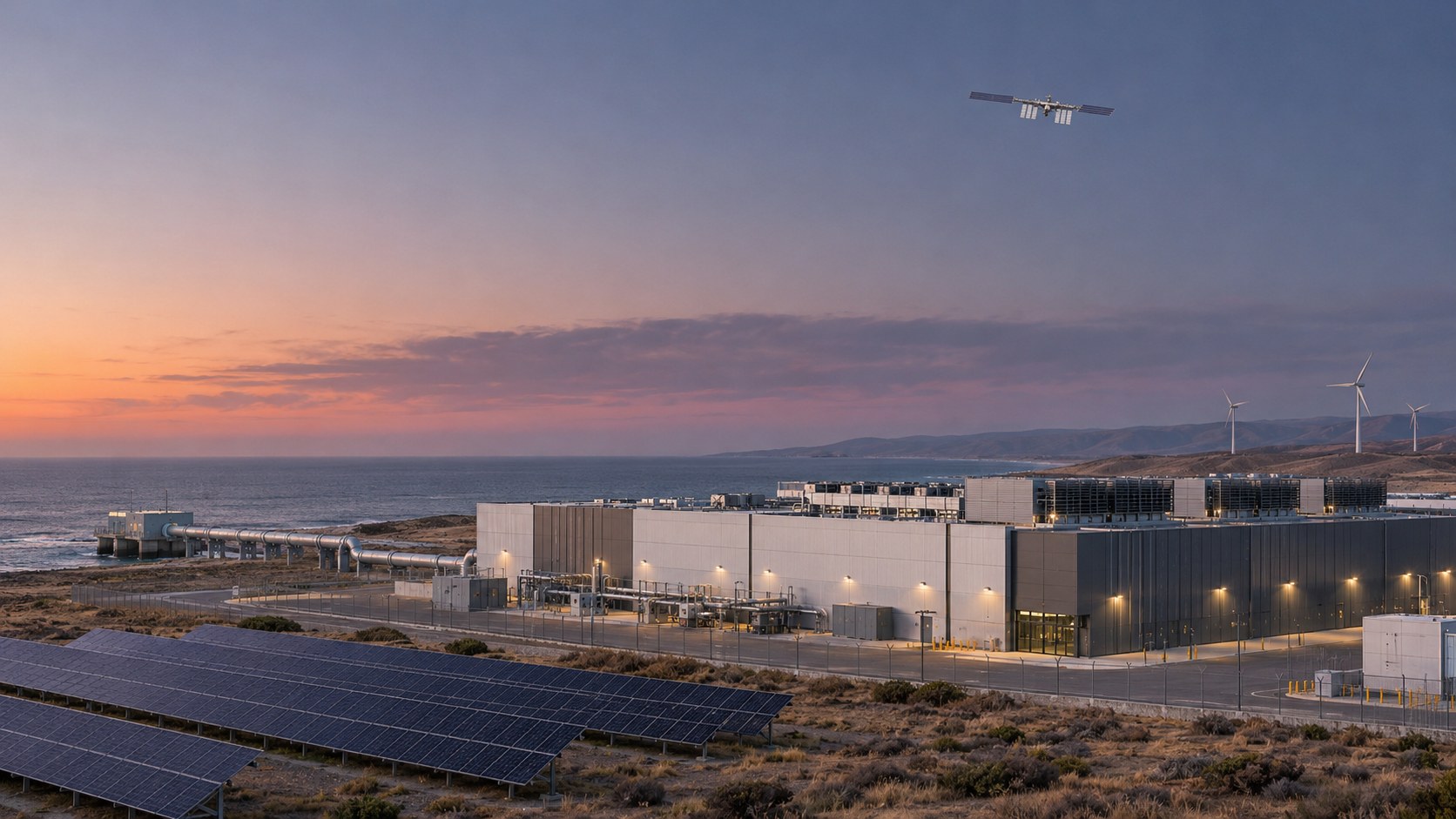
Putting AI hardware in space sounds like the kind of idea that gets better when described at altitude. The engineering gets less romantic as soon as the chips turn on. A 1-gigawatt computing load becomes 1.2 gigawatts of facility heat in this model, and in vacuum that heat has one main exit: radiation.
This series takes a rough orbital data center concept and makes its assumptions visible. It uses a 1-GW IT load, a 20% facility overhead allowance, NVIDIA DGX B200 systems as a mass and power proxy, and a deliberately simple radiator model. It is a thought experiment, not an announced xAI, SpaceX, or NVIDIA project.
1. The radiator is the data center
The Stefan–Boltzmann equation explains why a warmer radiator can be dramatically smaller, and why the hot-chip cases are thermodynamic thought experiments rather than a server operating plan.
Read the thermal analysis →2. A gigawatt of GPUs, counted by the tonne
Count the server systems, solar cells, radiators, support hardware and the implied launch campaign. The answer is hundreds of launches under optimistic payload assumptions.
Read the mass budget →3. Earth still has a data center advantage
Compare the orbital thought experiment with current data center construction benchmarks, solar generation, batteries and the energy cost of desalinating a large water supply.
Read the Earth comparison →Primary references
- NASA Passive Thermal Control Engineering Guidebook.
- NVIDIA DGX B200 system specifications.
- SpaceX Starship design page.
- JLL 2026 Global Data Center Outlook.
- U.S. Department of Energy photovoltaic cost benchmarks.
- NREL 2024 utility-scale battery storage assumptions.
- U.S. Department of Energy seawater desalination bandwidth study.