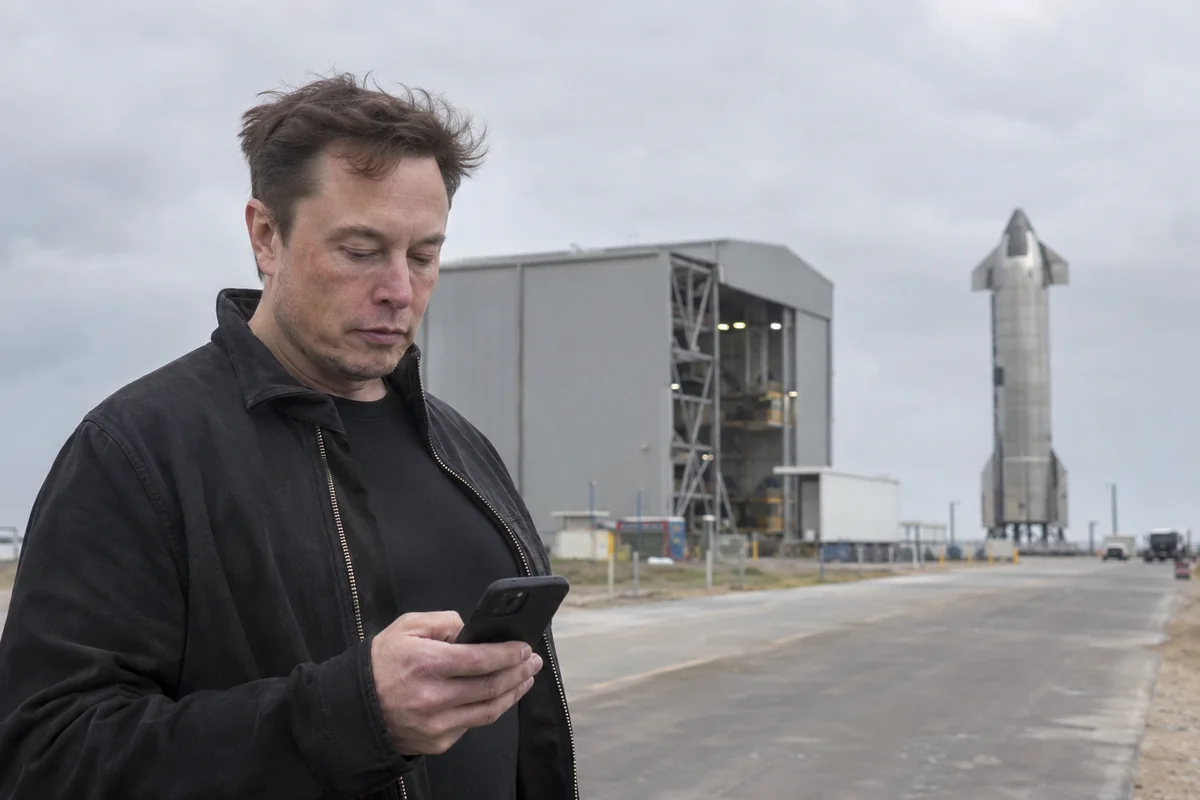
Start with a boy reading Isaac Asimov. Before the companies, the campaigns and the daily argument with half the internet, there was the appeal of a future large enough to be worth building.
In this essay
1. The future in the books
Musk has said that he read Asimov's Foundation as a child. The series imagines a galactic civilization collapsing and a plan to preserve knowledge through the dark age that follows. Its premise gave a young reader an unusually ambitious question: what could people build now to help civilization survive later? Musk has described the books as a lesson in prolonging civilization and reducing the chance of a dark age. That is a larger ambition than getting rich, getting famous or getting the car to stop updating itself at an inconvenient moment. It is also a useful way to understand why he made rockets sound like civilizational insurance rather than a luxury hobby for billionaires. [1] [2]
Asimov's technology is inspiring, too: robots, machines and engineering on a scale that makes a strange future feel tangible. The robot stories give machines a place in human society; Foundation imagines the infrastructure and knowledge needed to keep civilization alive across centuries. That imaginative world reaches beyond rockets. It makes tunnels, humanoid robots and ambitious machines feel like pieces of a future people might actually inhabit, rather than another row of gadgets pitched at a product launch. This is not a literal engineering blueprint for The Boring Company or Tesla's robots. It is the technological imagination that makes those projects legible as part of a larger vision. [2] [10]
2. 2002–2013: grief and construction
In 2002, Musk founded SpaceX. That same year, he and his first wife, Justine, lost their infant son Nevada to sudden infant death syndrome at 10 weeks old. There is no honest way to turn that loss into a tidy origin story for everything that followed. It was a private tragedy, not a plot device. [4]
Tesla was founded in 2003; Musk joined as chairman the next year. In 2006, its master plan set out the wager: start with an expensive sports car, use that to fund more affordable electric cars, then move the industry toward clean energy. The Roadster would prove the electric car could be desirable; later models would make it more accessible; batteries and solar power would extend the same idea beyond the driveway. Ambition, but with a sequence and a business model. Musk became chief executive in 2008. [5]
SpaceX's path was no less audacious and rather more explosive. After three failed Falcon 1 launches, the fourth reached orbit in 2008. That December NASA awarded SpaceX a contract for 12 cargo missions to the International Space Station. It was a public contract, won by a private company that had survived long enough to deliver. A decade later, reusable Falcon 9 boosters and Dragon made the improbable business case visible: launch, land, fly again; carry cargo, then astronauts. The idea of making spaceflight routine was no longer just a line in a book. [36] [37] [43]
His politics in those years were not a simple story of partisan loyalty. He gave to Democrats and Republicans, including matching donations to California governor candidates Jerry Brown and Meg Whitman in 2010. In 2011, he gave $35,800 to Barack Obama's reelection committee, while also supporting Republican candidates and committees. The Democratic giving was not decorative: it supported candidates and a party whose clean-energy agenda helped create the market Tesla needed to survive. The pattern was already a mix of environmental preference, access and the practical business of getting things built. He was not a movement loyalist so much as a builder looking for the coalition that might put real money, policy and institutional weight behind a future. [6]
That public-private bargain became visible when Tesla repaid its Department of Energy loan, with interest, nine years early in 2013. The program was authorized under George W. Bush and the loan awarded under Obama. Government support and private risk had helped a new industry get moving. The future was not built by a lone genius in a garage; the garage had a very large public balance sheet behind it. That is not a knock on Tesla. It is what industrial policy looks like when it works: public money takes a risk, a company executes, taxpayers get repaid and the market gets a new option. The myth of the solitary founder is just more flattering than the spreadsheet. [7]
3. 2016–2021: tunnels, robots and a public snub
In 2016, Musk began talking about digging tunnels to escape traffic; The Boring Company followed in 2017. The pitch was almost childishly simple in the best sense: traffic is awful, so build a new layer of the city underneath it. Asimov did not hand him a tunnel-boring machine design. But science fiction gave the tunnel its emotional charge: here was a stubborn, physical problem that could be attacked with engineering until the future made room for itself. The same impulse would later animate Tesla's humanoid robots. The promise was not that every machine would work on schedule; the promise was that things people accepted as impossible could be tried. [8]
In September 2017, Musk said the goal was to wake up believing the future would be great. He also explained that Asimov's books taught him to try to prolong civilization and reduce the chance of a dark age. In June 2018, he called the Foundation series and Asimov's Zeroth Law “fundamental to creation of SpaceX.” That is not a casual name-drop. The book supplied a moral scale for the work: the project was bigger than a product cycle, bigger than one lifetime, potentially bigger than Earth. [1] [2] [3]
In 2020, Musk's daughter Vivian was 16. In her later account, he initially hesitated and then knowingly consented to her treatment. Her transition was hers; the conflict was about how her father handled it. [9]
On August 5, 2021, the Biden White House held an electric-vehicle event with GM, Ford and Stellantis. Tesla was left out, with the administration pointing to union issues. The event was supposed to advertise a national EV target; instead, the most successful American EV maker was missing from the picture because it was non-union. A policy dispute became an insult with cameras. [11]
Later that month, Tesla unveiled a humanoid-robot concept. The machine followed the futurist pitch: automation could expand what people are able to do. Asimov's robots were never a Tesla product roadmap, but the books' technological imagination is part of what makes such ambitions inspiring. The technology Musk wanted to build—tunnels and robots as well as rockets—carried that sci-fi appeal into the present. [10]
In November, Biden visited GM and told its chief executive, Mary Barra: [12]
“You electrified the entire automobile industry. I'm serious. You led.”
Joe Biden, November 17, 2021. [12]
That was a clumsy way to talk about the electric-car revolution while Tesla was the company that had spent years forcing the industry to take it seriously. Biden did not just thank GM; he crowned it the leader of a revolution Tesla had spent years dragging into the room. There was a real slight in the choice of stage and words. There was also a wider policy agenda that still backed EVs, including the clean-energy incentives Tesla could use. The betrayal was therefore not that Democrats suddenly turned against electric cars. It was that they could fund the transition and still tell the story as if Tesla had not helped make it possible. For Musk, the symbolic slap was easier to remember than the policy win. A slight makes a cleaner villain than a tax credit.
4. 2022: Twitter, politics and family
In April 2022, Musk agreed to buy Twitter for about $44 billion. He called it “the digital town square where matters vital to the future of humanity are debated.” Noble slogan; unusual civic improvement plan, buying the square and keeping the loudest microphone for yourself. The deal pulled Musk from companies that make things into a company that mediates what people see, say and fight about. SpaceX and Tesla required years of engineering, hiring and manufacturing. Twitter offered instant audience, daily conflict and a button marked post. It is easy to see why it became the more addictive machine. [13]
On May 18, he said he would vote Republican and that Democrats had become the party of “division and hate.” It was a striking turn for someone who had given to Obama and built an electric-car company whose early growth was helped by government policy. The shift did not happen in one day; the public declaration made it hard to pretend it had not happened. There were grievances, especially the Biden snub. But that one insult became a convenient master key for a much wider political conversion. [14]
In June, Vivian, then 18, legally changed her name and asked not to be associated with her father. Her name and her boundary are hers. The public record offers a painful family rupture, not permission to invent what either of them feels in private. That distinction would soon matter, because her estrangement became raw material in her father's political story. [9]
5. 2023–2024: the road to Trump
In 2023, Musk hosted Ron DeSantis's presidential launch on Twitter. By then the platform itself was a political instrument: a private owner could set the rules of the town square, amplify allies and make his own arguments reach millions. The tunnel project and the rockets still existed. So did the older promise that technology would widen the future. But Twitter was consuming the spotlight—and a great deal of its owner's attention. The companies built the audience by doing difficult things in the real world; now the audience itself was the product and the political machine. [15]
By 2024, the turn was visible in both money and message. Musk amplified claims that immigrants were invading the country, that undocumented immigrants were voting, and that Democrats were bringing them in to change the electorate. Those claims were false or misleading. The old internationalist talk of humanity's long future was giving way to a politics organized around the people supposedly stealing the country from its rightful owners. A man whose own life and companies crossed borders was now helping turn immigrants into a threat. [42]
On July 13, 2024, Musk endorsed Donald Trump after the assassination attempt in Pennsylvania. He had once called Trump the wrong man for the job; now he called him “tough.” During the campaign, Musk's America PAC funded canvassing and voter outreach, while his posts pushed Trump's case to an enormous audience. He was not merely cheering from the sidelines; he helped build the campaign's ground game and paid for the megaphone. The campaign-finance records eventually tallied at least $288 million in political spending supporting Trump and other Republicans. That is a lot of money to spend on a man you once considered unfit for office. [16] [17]
On July 22, Musk told Jordan Peterson he had been “tricked” into consenting to Vivian's treatment at 16 and said he had “lost” his son. The gap between his earlier consent and his later story is the painful hinge: a father describing a daughter's life as a loss, then turning that loss into political ammunition against the people who affirm her. Guilt is a plausible reading of the reversal, though no one can diagnose his private mind from a podcast. Vivian's own account is clear: she is his daughter, and she says he knew what he was consenting to. [9]
On July 23, he argued that removing EV support would hurt Tesla's competitors more than Tesla. That was the company-first answer. It did not sound much like the old mission to accelerate the world's transition to sustainable energy. [18]
On July 25, Vivian told NBC that Musk initially hesitated, then knowingly consented. He later described her as “dead” and “killed by the woke mind virus.” This is not an argument about the future of civilization. It is a father publicly erasing his daughter's identity, then making her transition stand in for a civilization-threatening ideology. The grandest possible stage for the most intimate possible grievance. [9] [40]
Trump was an unlikely political bedfellow for a man who had made electric cars, science and rockets central to his public identity. He was also an ideal ally for someone now treating immigrants, trans people and “woke” as enemies of civilization. Resentment can make a coalition feel like destiny. Musk could resent Biden's treatment of Tesla and still be responsible for the ally he chose.
6. 2025: the electric future, DOGE and the rupture
In January 2025, Musk joined Trump's Department of Government Efficiency. He had sold the project as a way to find as much as $2 trillion in cuts; before it even began, he was already calling that a best-case scenario and admitting it probably would not happen. A $2 trillion promise had lasted just long enough to become a campaign prop. [41]
In the first quarter, Tesla sales weakened amid stronger competition, an aging product lineup and backlash to Musk's politics. Reuters reported a 13 percent drop in deliveries, citing both political backlash and global competition. The spectacle was impossible to miss: the man who had spent years making Tesla the shorthand for the electric future was now standing beside a chainsaw, celebrating the demolition of government programs and institutions that shaped the market his companies depended on. [19]
That backlash did not just punish Tesla. It slowed the electric-car transition. For a while, Tesla was one of the strongest electric-car choices on the market: a network of fast chargers, long range, good performance and a name people associated with the category itself. Then some people decided they would rather not buy a very good car from a man they despised. The point is not that Tesla's competition vanished or that Musk alone explains every lost sale. It is that a founder who became a political brand made one of the industry's best-known EVs harder to choose. Customers did not need to hate electric cars to reject Musk's car; competitors happily took the sale. The transition lost momentum along with Tesla's market share.
In March, as Vivian spoke publicly about their estrangement, Musk used X to insinuate that trans people were behind attacks on Teslas. The pattern was becoming grotesque: political hostility toward him was recast as an attack by a hated out-group, even when evidence had not established the claims he was amplifying. Woke, immigrants, trans people: the list of villains grew as his own choices became harder to separate from the damage around him. [40]
In April, SpaceX won an estimated $5.9 billion for 28 national-security launches. That May, the FAA's environmental review covered increasing Starship operations at Boca Chica to as many as 25 launches a year, subject to approvals and conditions. The federal relationship was already lucrative, and the regulatory runway mattered. [30] [31]
On June 5, Musk called Trump's tax-and-spending bill “a disgusting abomination.” He also claimed credit for Trump's victory:
“Without me, Trump would have lost the election.”
Elon Musk on X, June 5, 2025. [23]
Then he accused the president of hiding an association with Jeffrey Epstein:
“@realDonaldTrump is in the Epstein files. That is the real reason they have not been made public.”
Elon Musk on X, June 5, 2025. [24]
Musk offered no evidence that this was why the records had not been released. The accusation was still a remarkable public break: Trump's biggest political benefactor was now accusing him of concealment. Trump is no innocent who needs Musk to defend his honor: he spent months lying about losing the 2020 election and tried to overturn its result; he was convicted on 34 felony counts and found civilly liable for sexually abusing E. Jean Carroll. Musk's post read as rage and score-settling, not a sudden discovery of principle. [25] [34] [35]
Trump threatened SpaceX contracts and subsidies. Musk briefly threatened to decommission Dragon, a spacecraft used for NASA missions, then backed down. This was two powerful men using public leverage against each other, with public infrastructure caught in the middle. [23]
On June 11, Musk wrote: “I regret some of my posts about President Donald Trump last week. They went too far.” The retreat was quick. [26]
On July 23, Musk said the end of U.S. EV support could mean “a few rough quarters” for Tesla. Congress had passed the rollback earlier that month. The policy contradicted the broader promise of accelerating electric-vehicle adoption. Musk had backed the political coalition that made it happen, while Tesla customers were already turning away from the man who had made the carmaker famous. [21]
In August, Trump ordered steps intended to streamline commercial-space regulation. On September 30, the federal clean-vehicle credits ended for new acquisitions. In October, Yale economists estimated that Musk's partisan turn cost Tesla between 1 million and 1.26 million potential U.S. sales through April 2025. That is a very large headwind for one of the electric-car industry's biggest sellers. When buyers reject a strong EV because they do not want to buy from Musk, the electric transition loses momentum along with Tesla. [20] [22] [32]
In December, Musk said DOGE had been “somewhat successful,” that he would not do it again, and that he might have spent the time on his companies instead. For a moment, it sounded as though the cost of the political detour had become visible to him. [27]
7. 2026: the audit, then the return
In August 2026, the Government Accountability Office audited the “Wall of Receipts,” which was still claiming $110 billion in savings. Its findings were less cinematic than the chainsaw, but rather more useful: DOGE did not follow its stated method for most contract savings; it supplied too little information to verify 96 percent of its reported grant savings; and 108 of the 264 leases it counted had already been headed for termination. In one example, DOGE claimed $1.7 billion in savings on a Defense Health Agency IT contract, then did not terminate it, reduce its scope or cut its funding. The savings were still on the wall. The agency had done nothing. GAO did identify potential savings elsewhere, so the finding was not that every DOGE action saved nothing. It was that a project sold as a revolution in accountability could not reliably account for its own numbers. [28]
In October, Reuters reported that Musk had spent about $366 million in the 2026 cycle to help Republicans retain Congress, including $276 million since July. The break with Trump did not become an exit; the feud had passed, and the money was back. [29]
On October 17, in a new interview with Walter Isaacson, Musk finally described DOGE in language closer to the record. “No way we were gonna solve the deficit from within the government,” he said. He admitted he had “kinda got carried away” and been “gone for too long” from Tesla and SpaceX. When Isaacson asked if the White House had been seductive, Musk said it was “a little bit,” because it was “kinda cool” to be in the Oval Office as momentous decisions were made. There is the brief opening of the eyes: the deficit was not getting fixed; the companies were missing their chief executive; and power, it turned out, was fun. [38]
On October 22, Musk said SpaceX and Tesla had each formed special committees to discuss a possible combination. At current market values, the deal would create a company worth about $3.5 trillion. SpaceX's own investor filing warned that a change in congressional control could materially harm its growth and competitive position. The returns from political influence were no longer an abstract suspicion; the company had put the political risk in its own filing, while its founder was spending hundreds of millions to shape that political landscape. [39]
That is the Greek-tragedy turn: not that a man made a mistake, but that he saw enough of the cost to name it and then chose the same alliance again. DOGE briefly made him look back at the work he had abandoned. The Republican money and the merger talks show where he looked next.
8. Was it always about the rockets?
The strategic reading is that the feuds, the political spending, the Twitter takeover and the DOGE detour all served a high-stakes effort to maximize SpaceX's profits, market value and freedom to fly ships more often. The moves did not need to look coherent to the public. They needed to improve the position.
The pieces are there in the public record: SpaceX's multibillion-dollar national-security contracts; a launch business whose growth depends on the pace of approvals, sites and flight cadence; a White House order directing agencies to expedite reviews and remove regulatory barriers for commercial space; and Musk's extraordinary investment in the party controlling those agencies. His companies had spent years battling over environmental reviews and launch permissions. The administration then made faster commercial-space approvals an explicit policy objective. For a rocket company trying to launch more often, that is not a side issue. It is the road to revenue. [30] [31] [32]
The scale of the relationship matters, too. SpaceX is a major national-security launch provider with contracts worth billions, and the government is also its regulator, customer and gatekeeper. Musk's own company has warned investors that a change in congressional control could materially damage its growth. That is an unusually plain description of the political stakes from the company itself. Musk spent accordingly: hundreds of millions in elections, a public platform on which he could set the daily agenda, and a temporary seat in the government whose decisions shape the market. He had not wandered into politics; he had invested in it. [29] [39]
Buying Twitter was not merely a distraction from influence; it gave him a channel to manufacture it. DOGE brought access to the agencies, contracts and rules that shape aerospace. The Trump alliance could be worth more to SpaceX than a clean personal reputation was worth to Tesla. And a potential SpaceX–Tesla merger could convert that web of contracts, launch access, vehicle businesses, satellites, AI and political influence into an even larger financial machine. A cynical calculation, but at least one with a spreadsheet behind it.
There is one caveat: incentives make a theory plausible, but they do not prove a master plan.
The sad part is that the ambition was once broad enough to include everyone in the future. The rockets are still going; the question is whether Musk can remember why he wanted them to.
Sources and reading notes
This essay distinguishes documented events from interpretations of motive. Sources establish the public record; they cannot establish a private state of mind. Coverage reviewed through October 23, 2026.
- Musk's June 2018 post on the Foundation series. Primary source.
- Rolling Stone interview: Musk on civilization and science fiction. September 2017.
- CNN transcript: Musk's 2017 space-conference remarks. September 29, 2017.
- Justine Musk's personal account in Marie Claire. Nevada's death and family history.
- Tesla's 2006 master plan. Company primary source.
- Sunlight Foundation: SpaceX's early political giving. May 22, 2012.
- Tesla: Department of Energy loan repayment. May 22, 2013.
- El País: Musk’s tunnel announcement and the Boring Company’s origins. January 6, 2023.
- NBC News: interview with Vivian Jenna Wilson. July 25, 2024; includes her account of consent and family estrangement.
- Tesla: Tesla Bot announcement. August 2021.
- Reuters: Biden's August 2021 EV event and Tesla's exclusion.
- Official transcript: Biden at GM Factory Zero. November 17, 2021, page 3.
- SEC filing: Twitter acquisition announcement. April 25, 2022.
- Reuters: Musk says he will vote Republican. May 18, 2022.
- Reuters: DeSantis campaign launch on Twitter Spaces. May 24, 2023.
- Reuters: Musk endorses Trump. July 13, 2024.
- Washington Post: final 2024 campaign-finance tally. January 31, 2025.
- Reuters: Musk says EV-support cuts would hurt competitors more. July 23, 2024.
- Reuters: Tesla's first-quarter 2025 sales decline. April 2, 2025.
- Yale economists, National Bureau of Economic Research: The Musk Partisan Effect on Tesla Sales. October 2025.
- Reuters: Musk says end of U.S. EV support could mean rough quarters. July 23, 2025.
- IRS: clean-vehicle tax credits. Primary guidance on the September 30, 2025 acquisition cutoff.
- Reuters chronology of the June 2025 Trump–Musk feud. Preserves posts, threats and reversals.
- ABC News: June 5, 2025 exchange and Epstein allegation.
- U.S. House Select Committee: January 6 final report and Trump’s efforts to overturn the election.
- ABC Australia: Musk regrets some of his posts. June 11, 2025.
- Reuters: Musk says DOGE was somewhat successful and he would not do it again. December 10, 2025.
- GAO: DOGE's Wall of Receipts. August 6, 2026.
- Reuters: $366 million in 2026-cycle political spending. October 12, 2026.
- U.S. Space Force: National Security Space Launch awards. April 4, 2025.
- FAA: Starship environmental-review archive. May 2025 materials.
- White House: commercial-space regulatory initiative. August 13, 2025.
- Reuters: SpaceX–Tesla deal and estimated valuation. October 22, 2026.
- Reuters: Trump’s 34-count felony conviction remains in effect. August 28, 2026.
- Reuters: Supreme Court declines Trump appeal of the Carroll civil verdict. June 29, 2026.
- NASA history: SpaceX wins its first cargo resupply contract. December 23, 2008 award; retrospective published January 9, 2024.
- NASA: Commercial Crew and SpaceX's first crewed flight. Falcon 9 first-stage reuse and the May 2020 crew launch.
- Axios: Musk tells Walter Isaacson DOGE could not solve the deficit, admits he was away from his companies too long. October 17, 2026.
- Associated Press: SpaceX and Tesla form committees to discuss a possible merger; company filing warns of political risk. October 22, 2026.
- CNN: Musk insinuates trans people are behind Tesla attacks as Vivian speaks about him. March 20, 2025.
- Reuters: Musk acknowledges his $2 trillion federal spending-cut target is a long shot. January 9, 2025.
- PolitiFact: How Musk amplified false or misleading claims about immigration and voting. April 2, 2024.
- NASA chronology: Falcon 1 succeeds on its fourth launch after three failures. 2008 events.