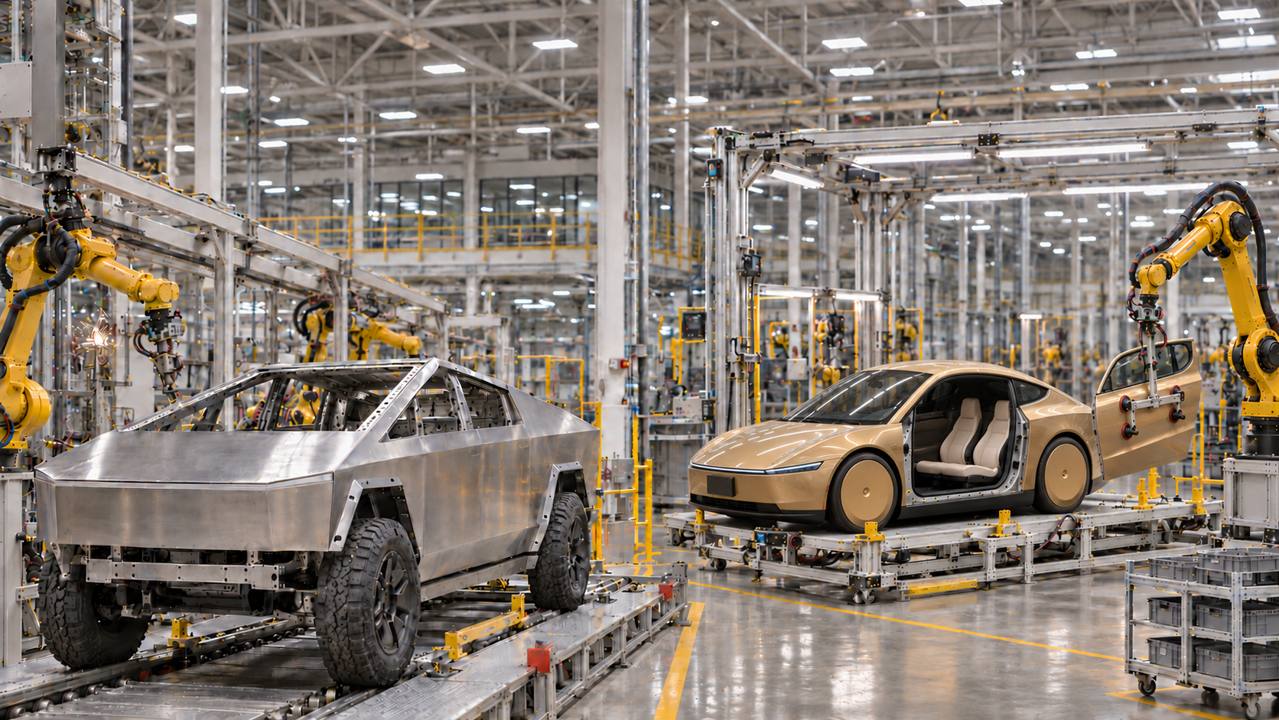
Tesla’s Texas factory is facing a choice about what deserves scarce production space. The Cybertruck brought a distinctive design and a long queue of reservations, but U.S. sales have fallen far short of the company’s early volume ambition. Tesla now plans to use more of the factory for Cybercab production, a vehicle intended for automated transport.
That is the strategic case. It is not proof that the Cybertruck loses money or that the Cybercab will make money. Tesla does not publish profit per vehicle for either model, and robotaxi operations still have to prove they can run safely, legally, and with high enough utilization.
Sales fell far short of the original scale
Tesla does not break out Cybertruck deliveries in quarterly reports. The most useful public counts are Kelley Blue Book estimates of U.S. sales, not Tesla-reported global totals. They show 38,965 in 2024, 20,237 in 2025, and 11,586 through the first nine months of 2026.[2][3]
The 2026 count is partial year. The chart also shows the simple pace implied by those nine months, about 15,448 for a full year if sales stayed even. That is arithmetic, not a forecast.
Tesla says the Cybertruck order backlog exceeds what it can build before it winds down the line around mid-2027. But a reservation list is not the same as customers taking delivery at today’s price. Musk has said many deposits may need to be returned because the line will run out of time to fill the remaining orders.[5]
The constraint is a mismatch between a specialized production system, realized sales, and the value Tesla believes it can get from the same factory space.
Why the Cybertruck is hard to make
The stainless-steel exterior is more than a styling choice. Stainless steel is difficult to form into large, consistent panels, and its exposed surface makes small dents, scratches, and variations hard to hide with paint. Tesla chose an angular shape and thick sheet metal that require dedicated forming, cutting, joining, and quality-control work.
There is a tradeoff: skipping conventional paint can remove a major factory process, but it does not make the rest of the body easy. Large visible panels have to fit cleanly, and the material can spring back after forming. A 2025 recall covered certain trucks whose stainless-steel cantrail panel could separate at its adhesive joint. That does not establish that the whole design is defective, but it shows how a novel material and joining method can add quality-control work of their own.[6]
Low volume makes the economics harder. Specialized tooling, supplier engineering, inspection steps, and line changes have to be spread over fewer vehicles than Tesla’s mass-market models. Public information does not reveal the Cybertruck’s per-unit manufacturing cost or profit. The evidence supports a conclusion about volume risk and factory opportunity cost, not a claim that each truck is sold at a loss.[7]
What makes the Cybercab simpler to assemble
The Cybercab is a two-seat vehicle designed around autonomous transport. It has no steering wheel or pedals, and its small cabin and limited configuration choices leave fewer conventional car parts and options to assemble. Removing controls does not remove engineering work: sensing hardware, compute, wiring, thermal management, and safety validation still have to be integrated and tested.
The larger manufacturing difference is Tesla’s “unboxed” approach. Instead of building a complete body shell and then adding nearly everything in sequence, the factory can assemble major areas such as the front, rear, sides, and floor in parallel. Workers and machines install components in these modules before joining them late in assembly. A Munro walkthrough with Tesla engineering leaders described roughly 25 final assembly stations and about 78% automation.[8]
Reports from the walkthrough also describe molded exterior panels with color built into the material, which could avoid conventional paint for those panels. Parallel assembly, fewer separate body parts, and a constrained configuration can reduce steps and floor space. Those are credible ways to simplify production, but the savings remain a design goal, not an audited comparison with the Cybertruck.
The real bet is the business model
A Cybertruck is sold once. A Cybercab operated as a robotaxi could earn fares over thousands of trips during its service life. If Tesla owns the fleet, it can potentially capture ride revenue instead of relying only on a vehicle sale.
Musk has described a Cybercab price target below $30,000. That is a target, not a confirmed current price and not the factory cost.[9] The fleet economics only work if autonomous rides can be offered legally and safely, vehicles stay busy, and trip revenue exceeds charging, cleaning, maintenance, insurance, depreciation, remote support, and fleet-management costs.
There is one useful benchmark from Tesla’s Q3 2026 earnings call. CFO Vaibhav Taneja said the company was not yet at its $0.30-per-paid-mile cost target, and said fleet operations such as pickup, drop-off, and cleaning were still being dialed in.[10] That is a company goal, not a reported current cost or profit margin.
Tesla says it began providing robotaxi rides using Cybercabs in Austin on September 3, 2026.[4] That is a launch milestone, not proof of mature fleet economics. Tesla has not published Cybercab cost per mile, fleet utilization, or model-specific profit figures that would let outsiders confirm the business case.
Why Tesla is shifting factory capacity
Factories are valuable because they turn buildings, equipment, and workers into products. When a line is specialized and sales run below its practical capacity, each additional truck competes with the next-best use of that space. Tesla plans to wind down Cybertruck production at the Texas site around mid-2027 and redirect resources toward more Cybercab output. It also says it will add a shift first to fill as many existing orders as possible.[1][5]
Cybercab offers two possible advantages: a vehicle intended to need fewer assembly steps, and a fleet business that could generate repeated ride revenue. The second advantage has far more upside, but it is also less proven. If robotaxis are delayed, restricted, underused, or expensive to operate, a simpler vehicle will not by itself make the investment pay off.
The defensible reading is that Tesla is reallocating factory capacity toward the future it values more, not that the Cybertruck has been proven unprofitable or that the Cybercab has proven profitable. Watch actual Cybercab production, deliveries, safety approvals, paid miles, and the cost to keep each vehicle on the road.
The Cybertruck’s factory challenge is real: a complex product needs enough buyers to justify a specialized line. The Cybercab’s promise is conditional: simpler assembly matters only if the autonomous fleet earns more than it costs to build and operate.
Sources
- Reuters, Tesla to wind down Cybertruck production at Texas factory around mid-2027. November 6, 2026.
- Cox Automotive / Kelley Blue Book, 2024 U.S. EV sales report. Cybertruck model estimate.
- CBS News, Cybertruck sales plunged 48% in 2025, citing Kelley Blue Book; and CarPro, best-selling pickups through Q3 2026, citing Kelley Blue Book estimates.
- Tesla, Q3 2026 Update. Installed capacity, caveat on current output, and Austin Cybercab robotaxi rides.
- Reuters, Tesla to refund many Cybertruck deposits as demand exceeds production, Musk says. November 9, 2026.
- NHTSA recall report 25V-170. 2025; possible separation of the cantrail panel at its adhesive joint on certain 2024–2025 trucks.
- Tesla Investor Relations. Public quarterly results do not disclose Cybertruck-specific profit.
- Munro & Associates, Tesla Cybercab factory walkthrough. Technical tour with Tesla engineering leadership.
- Reuters, Tesla robotaxi event: Musk’s Cybercab price target. October 11, 2024.
- Tesla, Q3 2026 financial results and earnings-call webcast. CFO Vaibhav Taneja said the company was not yet at its $0.30-per-paid-mile cost target.